
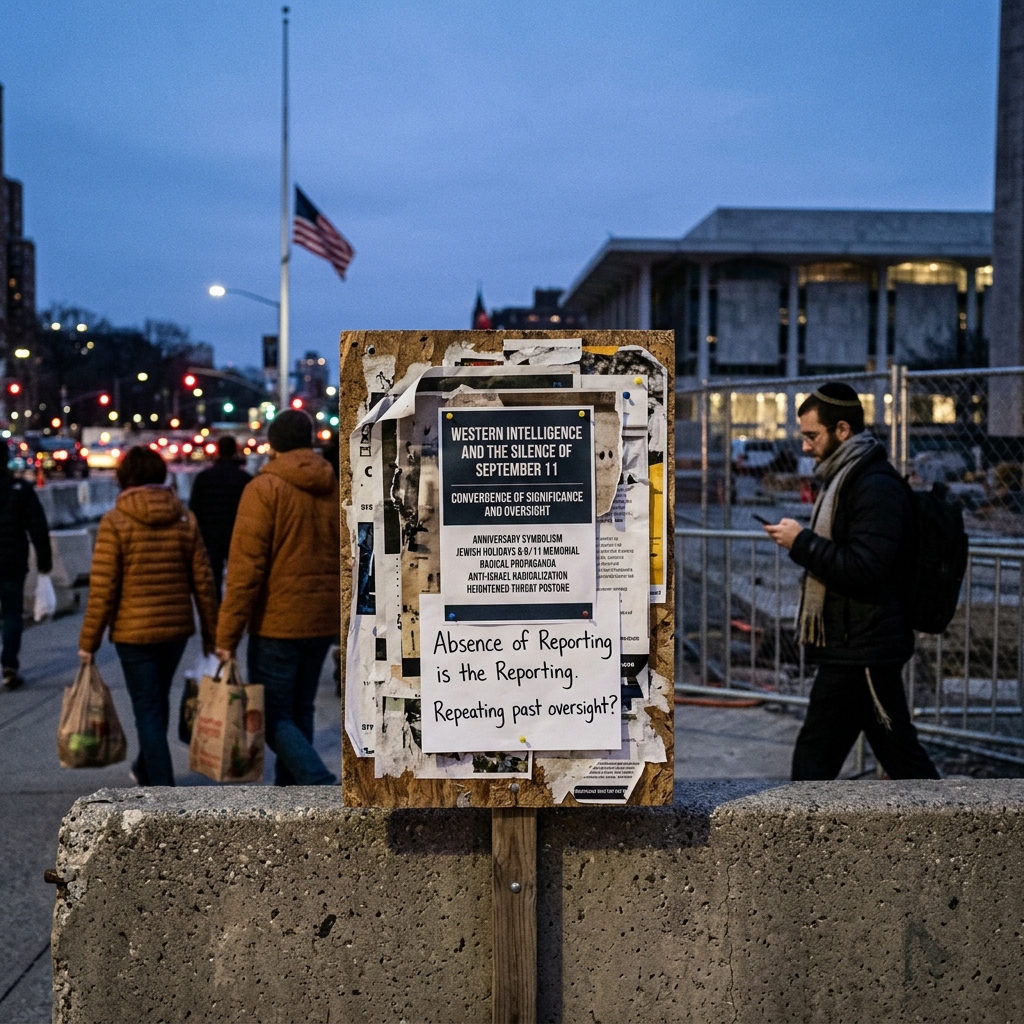
25th anniversary of 9/11; Rosh Hashanah; risk to New York City, other major U.S. cities, Israel, and Jewish or American targets abroad
“Those who cannot remember the past are condemned to repeat it.” — George Santayana
“If you know the enemy and know yourself, you need not fear the result of a hundred battles.” — Sun Tzu
Threat Analysis
September 11, 2026 marks the 25th anniversary of the attacks on the World Trade Center, the Pentagon, and the likely Capitol target stopped by passengers over Pennsylvania. It also opens Rosh Hashanah at sundown. That alignment should be a red flag for every Western-aligned threat intelligence agency globally. Yet there has been little mainstream reporting and no identifiable public government threat brief addressing the risk posed by ideologically motivated extremist groups on this anniversary.
The silence potentially indicates a greater threat: the decline of American military supremacy. The war with Iran and the open conflict between Israel and Iranian-backed groups have widened the threat picture. DHS warned in 2025 that the Israel-Iran conflict created a heightened threat environment in the United States, including possible cyberattacks, acts of violence, and antisemitic hate crimes. Sun Tzu warned about the danger of failing to know the enemy. Santayana and Churchill warned that those who fail to remember history are condemned to repeat it. This moment suggests we are close to doing both.
Islamic extremist groups have repeatedly used dates, holidays, anniversaries, and religious narratives to increase psychological impact. The first September 11 may have been selected for the same day in 1683 that marked the end of the Ottoman siege of Vienna before the Christian coalition victory on September 12. Also of symbolic significance, al-Qaeda selected the World Trade Center, the Pentagon, and likely the White House because those targets represented American power.
Al-Qaeda repeatedly stated its ambition to kill Americans years before succeeding in its largest attack on September 11, 2001, when nearly 3,000 people died. Bin Laden’s 1996 and 1998 declarations framed the United States as an occupying and corrupting power in the Muslim world. He cited American forces in Saudi Arabia, sanctions against Iraq, and U.S. support for Israel, then folded those claims into a broader “Jews and Crusaders” narrative used to justify violence against Americans and their allies, including civilians. Al-Qaeda used ideology, spectacle, civilian mass casualties, and symbolic targeting to turn New York into a battlefield message.
October 7 followed the same date-selection logic. Hamas launched “Operation Al-Aqsa Flood” at dawn on October 7, 2023, during Simchat Torah, a major Jewish holiday. The attack also fell almost exactly 50 years after the Yom Kippur War began on October 6, 1973. Hamas framed the assault around Al-Aqsa and Jerusalem, then struck when Israeli civilians were gathered for holiday, Sabbath, and festival observance. The date selection amplified the antisemitic message for a global audience.
The Yom Kippur War is another clear historical example. On October 6, 1973, Egypt and Syria launched a coordinated surprise attack on Israel on Yom Kippur, the holiest day of the Jewish calendar. The timing carried military and psychological value.
Many soldiers were home or in synagogues when Egypt crossed the Suez Canal into Sinai and Syria attacked the Golan Heights. Israel recovered, counterattacked, and survived, but the opening shock should have become a permanent lesson in how the enemies of Israel and America use date selection. Major attacks and conflicts have repeatedly aligned with anniversaries, Jewish holidays, Islamic narratives, or moments of national symbolism. Dates carry meaning for these groups. They create propaganda value, psychological impact, and operational opportunity. September 11, 2026 should therefore be treated with elevated threat concern because it combines the 25th anniversary of 9/11 with Rosh Hashanah, New York, Israel, and the post-October 7 threat environment.
Bottom Line
The weekend of September 11 is a convergence of symbolic and religious significance as well as strategic opportunity during memorial and holiday observances. The absence of reporting on the threat is itself significant because it suggests Western intelligence agencies may be repeating past oversight. Anniversary symbolism, Jewish holiday and 9/11 memorial observance, jihadist propaganda, Iranian-backed terror-organizations, and anti-Israel radicalization all support a heightened threat posture.
- September 11, 2026 is the 25th anniversary of the al-Qaeda attacks on the United States.
- Rosh Hashanah begins at sundown on Friday, September 11, 2026 and continues through Sunday night, September 13, 2026.
- The date places Jewish worship, 9/11 memorial activity, New York symbolism, Israel-linked threat narratives, and Iran conflict spillover in the same period.
- DHS warned that the Israel-Iran conflict created a heightened threat environment in the United States, including possible cyberattacks, acts of violence, and antisemitic hate crimes.
- DHS also warned that recent homeland terrorist attacks have been motivated by anti-Semitic or anti-Israel sentiment and that the conflict could contribute to additional U.S.-based plots.
- ADL recorded 8,873 antisemitic incidents in the United States in 2023, a 140 percent increase from 2022, with 5,204 incidents occurring after October 7.
- The ADL audit found that 52 percent of post-October 7 incidents included references to Israel, Zionism, or Palestine, and that incidents at Jewish institutions rose 237 percent.
- CSIS and congressional reporting identify Iran-backed networks, including Hezbollah, Hamas, the Houthis, and Iraqi militias, as persistent threats to U.S., Israeli, Jewish, and Western interests.
Priority Areas of Concern
- New York City: Highest U.S. concern due to 9/11 symbolism, dense infrastructure, bridges, tunnels, subways, memorial sites, Jewish institutions, diplomatic presence, and global media visibility.
- Other American cities: High concern for synagogues, Jewish schools, Jewish community centers, Israeli-linked institutions, public ceremonies, transit hubs, crowded soft targets, and communities already exposed to post-October 7 intimidation or threats.
- Israel: High concern especially in light of the escalating war with Iran and the wider conflict with Hamas, Hezbollah, the Houthis, Iraqi militias, ISIS, al-Qaeda, and other extremist actors who continue to threaten Israeli targets.
- Jewish, Israeli, and American targets abroad: High concern for embassies, consulates, cultural centers, schools, synagogues, student organizations, businesses visibly linked to Israel or America, shipping, energy, and public events.
Iranian-Backed Threat Landscape
Iran has long used armed networks to project power against the United States, Israel, and Western-aligned targets while avoiding direct responsibility. Congressional research describes Iran-backed groups as part of an “Axis of Resistance” that includes Hezbollah, Hamas, the Houthis, and Iraqi militias. Those groups have attacked U.S., Israeli, and other targets for years. The number, pace, and scope of attacks increased after the October 7 Hamas-led assault on Israel. DHS has also warned that pro-Iranian hacktivists and cyber actors affiliated with the Iranian government may conduct attacks against U.S. networks during periods of Israel-Iran conflict.
This threat landscape adds another layer to the date-alignment risk for September 11, 2026. The threat now includes Iranian-backed groups, state-linked cyber actors, radicalized lone offenders, and anti-Israel activists operating in an environment where antisemitic rhetoric has moved from speech into threats, harassment, hoaxes, vandalism, and violence.
Most Likely Target Categories
- Synagogues, Jewish community centers, Jewish schools, and cultural institutions during Rosh Hashanah services and related gatherings.
- 9/11 memorial events, civic ceremonies, first-responder events, and nationally symbolic sites.
- Bridges, tunnels, transit hubs, and other high-visibility infrastructure in New York City and other major cities.
- Israeli diplomatic, cultural, educational, business, or community-linked sites.
- U.S. military, diplomatic, energy, maritime, and transportation interests that Iranian-backed groups frame as legitimate targets.
- Online targets connected to Jewish organizations, religious leaders, event registration, livestreams, donor systems, community communications, or U.S. networks exposed to pro-Iranian cyber activity.

Sources
- National Commission on Terrorist Attacks Upon the United States, The 9/11 Commission Report.
- FBI, “9/11 Investigation”.
- National September 11 Memorial & Museum, “Osama bin Laden’s 1998 Fatwa”.
- Encyclopaedia Britannica, “Siege of Vienna, 1683”.
- Associated Press via Religion News Service, “Citing Al-Aqsa Mosque, Hamas launches broad attack as Israelis celebrate Simchat Torah,” Oct. 7, 2023.
- Associated Press via Chicago Sun-Times, “Israel at war after Hamas attack on Simchat Torah,” Oct. 7, 2023.
- Encyclopaedia Britannica, “Yom Kippur War”.
- Office of the Director of National Intelligence, 2026 Annual Threat Assessment of the U.S. Intelligence Community.
- U.S. Department of Homeland Security, National Terrorism Advisory System.
- DHS, “DHS Issues National Terrorism Advisory System Bulletin Amid Israel-Iran Conflict,” June 22, 2025.
- ADL, Audit of Antisemitic Incidents 2023.
- CSIS, “The Many Faces of Antisemitic Terrorism in the United States”.
- CSIS, “Jihadist Terrorism in the United States: What the Data Tell Us”.
- Congressional Research Service, “Iran-Supported Groups in the Middle East and U.S. Policy,” Sept. 26, 2024.
- CSIS, “Escalating to War between Israel, Hezbollah, and Iran,” Oct. 4, 2024.
- CSIS, “Iranian Networks in the Middle East,” Mar. 6, 2025.