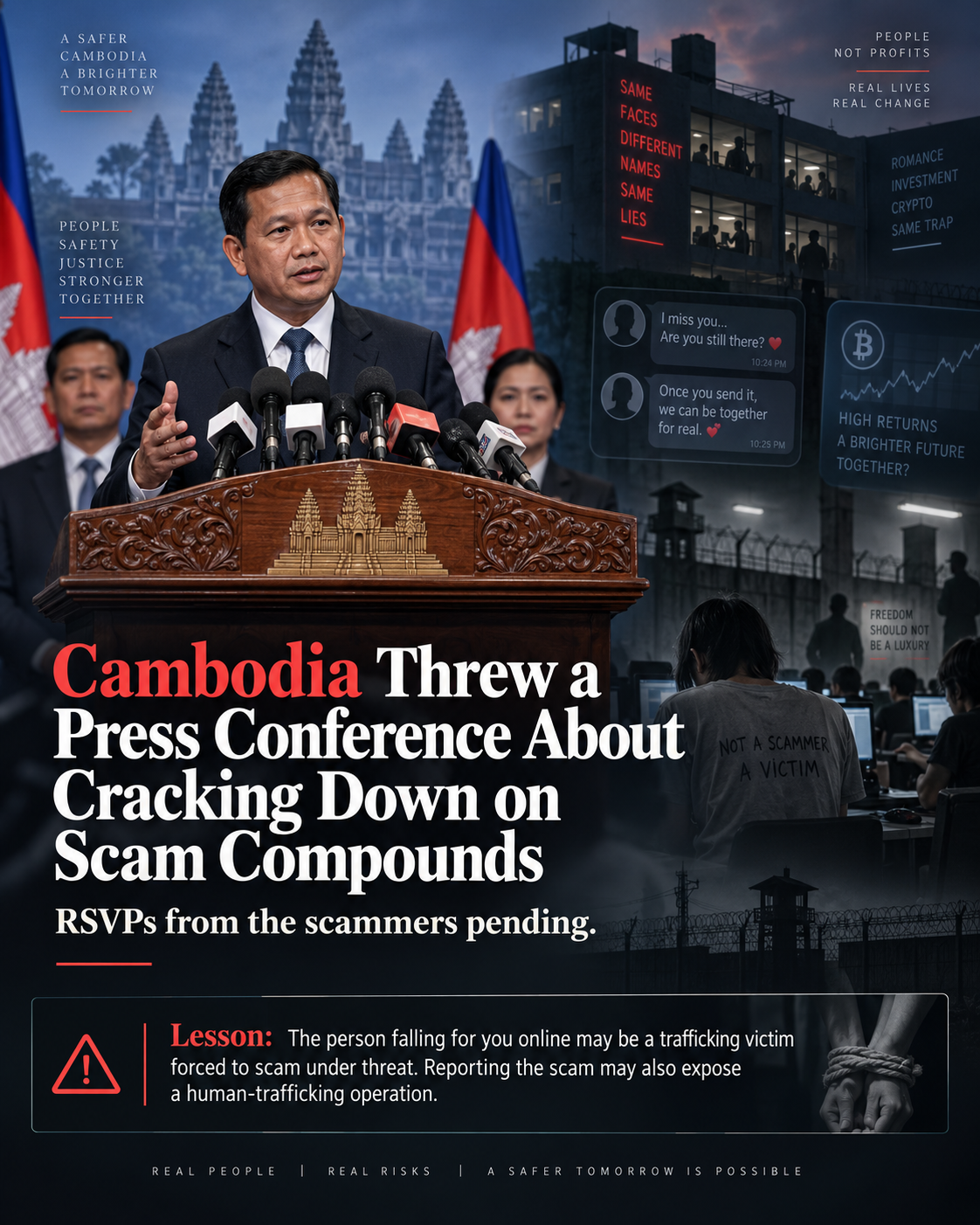
This week Cambodia hosted an international summit on shutting down the scam compounds operating inside its own borders. Around twenty countries sent delegations, Interpol and the UN Office on Drugs and Crime co-sponsored, and a senior FBI official shared the agenda with China’s vice minister of public security. The scammers themselves declined to attend.
To show the work, officials walked reporters through a shuttered compound — counterfeit cash still on the tables, and a fake police station the operators had built on site. These crews run police-impersonation fraud, so the prop has a certain logic. It’s still a strange thing to put on a tour.
You could be cynical about a government throwing a conference to prove it’s solving a problem it spent years being accused of tolerating. I’d rather give credit, because the effort is real and the work is genuinely hard. Cambodia’s anti-scam commission says it froze more than $300 million and dismantled 86 large-scale compounds in about fourteen months, sanctioned casinos, pulled licenses, and opened corruption cases against its own officials. When the core of the problem is protection from the inside, going after insiders counts. And getting twenty governments — including two rivals like the United States and China — into one room on this is exactly the coordination it takes.
There’s a long way to go, and the reasons are specific. Survivors report that operators are often warned before raids, allowing victims to be moved to other compounds or hidden until inspections end. Analysts say the industry has adapted, dispersing to smaller, lower-profile locations — a quieter province, or across the border into Myanmar or Laos. Shut one down and the network tends to reassemble somewhere with looser rules. So the applause and the realism belong together: good start, unfinished fight.
For you, none of the geopolitics changes the fundamentals. A stranger who can’t get on a video call, who moves fast, who eventually steers toward crypto or “just covering the transfer fee,” is a scam no matter what continent it runs from. Verify before you trust, and keep your money out of any relationship that lives only on a screen. When something’s off, report it — in the US, to the FBI’s IC3 (ic3.gov) and the FTC (reportfraud.ftc.gov). That report does more than log your case. It can hand investigators one more thread back to the operation itself.
The operation behind it is bigger than any single compound. UNODC now describes the region as a single interconnected criminal economy — criminals weaving cyber-enabled fraud, criminal infrastructure, and financial settlement into one shared operational system. Combined scam losses across East and Southeast Asia and the Pacific came to an estimated $88.3 to $114.1 billion in 2025 — a sum that, even at the low end, outstrips the GDP of several countries in the region. People from at least 80 countries have been identified inside these compounds. The scam you almost fell for and the enterprise running it aren’t neighbors. They’re the same business.
And that business runs on people. A UN human rights investigation this year — titled, aptly, “A wicked problem” — estimated around 300,000 people held in scam centers across the Mekong, recruited with promises of regular jobs, then detained and beaten once they arrived. Passports taken, forced to run scams as many as 16 hours a day. Investigators catalogued torture, forced labor, and sexual abuse inside the walls. One of their central recommendations is blunt and correct: build a “non-punishment principle” into law so trafficked victims are not prosecuted for crimes they were forced to commit. The person scamming you may be a captive who gets punished if you don’t fall for it.
Sources
The summit and the crackdown:
- Cambodia hosts anti-scam summit, seeking to showcase crackdown — BusinessWorld / Reuters
- Cambodia showcases scams crackdown with global conference — The Standard (HK) / AFP
- Cambodia’s Online Scamming Crackdown Stops at the Top — The Diplomat
- $300 Million Frozen, 86 Compounds Closed: The Real Scorecard on Cambodia’s Scam Crackdown — inkl
The trafficking and the wider criminal economy:
Human trafficking in Southeast Asia — IMF Finance & Development
Forced to scam: Inside one of the fastest-growing forms of human trafficking — UNODC
UN report exposes abuse in Southeast Asia’s scam centres (“A wicked problem”) — UN News / OHCHR
Follow that thread far enough and it stops being only about your bank account. The forces that let scam compounds thrive — deep poverty, weak rule of law, officials who can be bought, borders that don’t hold, and cryptocurrency that moves money faster than anyone can trace it — are the same forces that drive human trafficking of every kind. The compounds have been documented with casinos and brothels on the same grounds, and the recruitment networks that fill them overlap with the networks that traffic people for sexual exploitation. Across East Asia and the Pacific, children have long made up a significant share of trafficking victims, and sexual exploitation accounts for the largest share of cases. The recruiter, the corrupt border officer, the laundering channel, and the impunity are shared infrastructure. An economy that will imprison an adult to run a romance scam is the same economy that traffics a child, because it was never really about the specific crime. It was about people it could take and money nobody could follow. United Nations Office at Genevaimf
The fake police station is funny. The rest is not. This is one of the largest, fastest-growing criminal economies on earth, and it is paid for, dollar by dollar, by ordinary people getting scammed out of their savings from the safety of their own homes. UNODC
I spend most of my days on the small end of this — helping one person figure out whether the face on their screen is real before they send it money. On paper that has nothing to do with a UN report about compounds in the Mekong. In practice it’s the same fight from the other end. Every scam caught early is money that never reaches the machine. Every person who reports instead of going quiet is a thread someone can pull. Cambodia’s summit won’t end this, and it was never going to. But naming it honestly — one connected economy that traffics on every side of the wire — is how the countries in that room, and the rest of us outside it, start pulling the right threads.
Verify first. Report when it’s wrong. And don’t underestimate how much the small, careful decisions add up against something this big.
Sources: AFP / The Standard (HK), Reuters, The Diplomat, Digital Journal (Sept 21–23, 2026); UNODC, “An Interconnected Criminal Ecosystem” (2026); OHCHR, “A wicked problem” (2026); IMF F&D / Walk Free.