Why Combating Cybercrime Is Everyone’s Duty
Cybercrime has become so common that many people have grown numb to it.
Perhaps it’s because cybersecurity and cybercrime investigations are my profession, but I seem to hear about another victim almost every week. Recently, while attending a baseball game, someone shared the story of a local construction company that lost more than $60,000 to fraud. It wasn’t a headline or a news story. It was simply another business trying to recover from a crime.
What has captured my attention even more is the growing number of children targeted online through financially motivated sexual extortion. According to the FBI, more than 20,000 reports involving these crimes were received between October 2021 and March 2023, involving at least 12,600 victims and 20 suicides. Approximately 90% of identified victims were boys between the ages of 14 and 17.
These are not isolated incidents.
They are part of a criminal economy that spans the globe. Organized crime groups operate sophisticated scam compounds, exploit human trafficking victims as forced labor, leverage artificial intelligence to scale attacks, and target Americans through text messages, email, social media, dating applications, phone calls, fake investment platforms, and impersonation scams.
Unfortunately, many victims assume there is nothing that can be done.
Some report the crime to their local police department. Others simply absorb the loss and move on. Local law enforcement agencies often investigate these cases when resources allow, but cybercrime frequently crosses state and international borders, making investigations dependent on partnerships with federal agencies and international organizations.
Reporting cybercrime isn’t simply about recovering your own losses. Each report contributes intelligence that investigators use to identify criminal networks, connect related cases, identify infrastructure used by threat actors, and prioritize enforcement actions. Without reports, those connections are much harder to make.
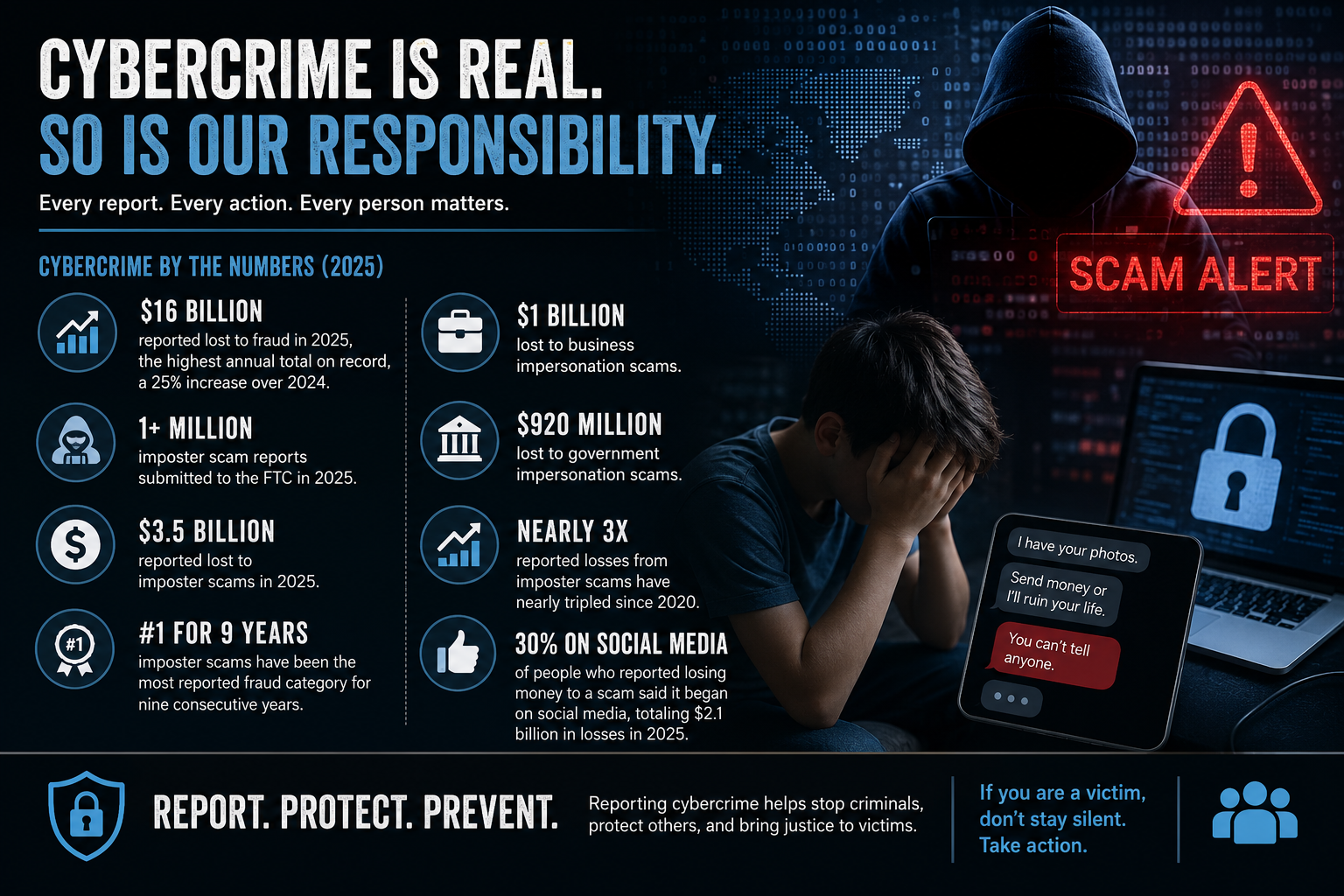
Cybercrime by the Numbers
The numbers show that cybercrime continues to grow in both frequency and financial impact.
- $16 billion was reported lost to fraud in 2025, the highest annual total on record and approximately 25% higher than 2024.
- Consumers submitted more than one million reports of imposter scams in 2025.
- $3.5 billion was reported lost to imposter scams alone.
- Imposter scams have remained the most reported fraud category for nine consecutive years.
- Consumers reported losing nearly $1 billion to business impersonation scams.
- Government impersonation scams accounted for approximately $920 million in reported losses.
- Reported losses from imposter scams have nearly tripled since 2020.
- Nearly 30% of people who reported losing money to a scam said it began on social media, totaling $2.1 billion in reported losses during 2025.

How to Report a Cybercrime
Aside from the most urgent actions, such as securing compromised accounts, changing passwords, enabling multi-factor authentication, contacting financial institutions, and preserving emails, text messages, screenshots, transaction records, and other evidence, ensure the incident is reported to the appropriate authorities.
Report to the FBI Internet Crime Complaint Center (IC3)
Website: https://www.ic3.gov
Report if the incident involves:
- Financial fraud
- Account compromise
- Ransomware
- Business email compromise
- Cryptocurrency theft
- Social engineering scams
- Unauthorized system access
- Most cyber-enabled crimes
Have available:
- Dates and times of the incident
- Suspect information, if known
- Email addresses, phone numbers, usernames, wallet addresses, websites, or social media accounts involved
- Transaction IDs and financial records
- Screenshots, emails, text messages, and other supporting documentation
IC3 reviews complaints, analyzes trends, and shares investigative leads with federal, state, local, tribal, territorial, and international law enforcement partners.
Report to the Federal Trade Commission (FTC)
General Fraud: https://reportfraud.ftc.gov
Identity Theft: https://www.identitytheft.gov
Report:
- Identity theft
- Imposter scams
- Online shopping fraud
- Romance scams
- Tech support scams
- Investment scams
- Other consumer fraud
Have available:
- Description of the incident
- Dates and financial losses
- Names of individuals or businesses involved
- Supporting documents and communications
FTC reports are used to identify fraud trends, support investigations, and guide consumer protection efforts.
Report Child Exploitation to the National Center for Missing & Exploited Children (NCMEC)
Website: https://report.cybertip.org
Report:
- Online child sexual exploitation
- Online enticement or grooming
- Child sexual abuse material (CSAM)
- Financial extortion involving a minor
- Any suspected online exploitation of a child
Have available:
- Usernames and account information
- Platform names and URLs
- Screenshots and chat logs
- Dates and times
- Any identifying information
If you already possess illegal images as evidence, do not redistribute or forward them. Report the incident immediately through the CyberTipline.
Notify Your Local Law Enforcement Agency
Consider filing a police report when the incident involves:
- Significant financial loss
- Threats or stalking
- Crimes involving children
- Insurance claims
- Banking disputes
- Legal proceedings
Bring:
- Government-issued identification
- A written timeline
- Copies of supporting evidence
- Financial records
- Any case numbers received from IC3, the FTC, or NCMEC
Notify Other Organizations When Appropriate
Depending on the incident, notify:
- Your employer or IT department if business systems or accounts were affected.
- Your bank or credit union.
- Your credit card issuer.
- Any cryptocurrency exchange or wallet provider involved.
- The online platform where the incident occurred.
- The three major credit bureaus to place a fraud alert or credit freeze.
- Your insurance carrier if cyber, homeowner’s, or business insurance may provide coverage.
Don’t Assume It’s Too Late
Victims may believe they have to “cut their losses.”
In reality, every case is different. Recovery opportunities, investigative leads, banking remedies, insurance claims, and law enforcement actions all depend on the specific facts of the incident and the available evidence.
Whether the goal is recovering funds, documenting what happened, supporting legal action, or preventing future victims, reporting cybercrime strengthens the broader effort against organized cybercriminals.
If you’ve been the victim of cybercrime, don’t assume nothing can be done. Even if weeks or months have passed, opportunities for recovery and accountability may still exist. For additional support in combatting cybercrime, email Countervail at contact@countervailintelligence.com for a free initial conversation, and guidance in determining the right next steps.